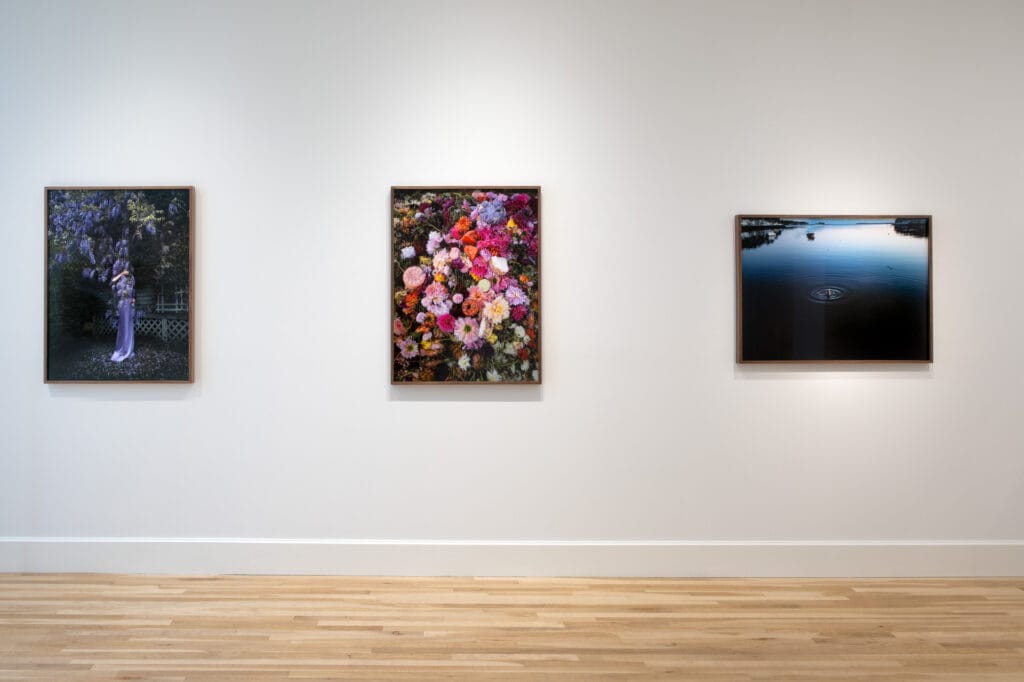
Cig Harvey’s ‘Emerald Drifters’ is on view at Jackson Fine Art through June 28. (Photos courtesy of Jackson Fine Art)
A pitch-black background dominates the composition. In the lower third, a small circular cake rests on a platter, its edifice heavily ornamented by cherries and rose petals and topped with still-lit candles slowly consuming themselves.
The Red Cake, Rockport (2023) is the most powerful artwork in Cig Harvey’s solo exhibition Emerald Drifters at Jackson Fine Art, not only because of its dramatic composition but because it beautifully describes the central theme of this show: Color, in all its hues, is first and foremost light. The works in this show explore the language of light and sight, offering a conversation which at times delights with its eloquence and grace and other times fumbles with bluntness.
The beauty of compositions like The Red Cake, Rockport is manifold. Emerging from complete darkness as the subject does, not only is the cake the only color in the composition, it is also the only thing visible, therefore inextricably interconnecting color with vision. Further, the cake itself is an illuminated subject. The candles that riddle the top of the cake are the only visible light source in the composition.
There’s that word again, “visible” — the subject is both color and light in equal parts. Importantly, the candles also serve as temporal devices, reminders that the scene captured here is slowly decaying and the candles are slowly devoured. Time, while not obviously connected to vision, serves an important role by encouraging the viewer to savor a fleeting moment.
In Harvey’s work, the nuance of color is revealed. While the title of the artwork would lead one to believe that the composition is composed entirely of reds, closer examination reveals fiery oranges, cool pinks and plum purples. Even one isolated color contains a spectrum of shades.
Elsewhere, the relationship between color and vision feels too on-the-nose. Grasping Wisteria, Camden, Maine (2021) depicts a figure wearing a floor-length lavender gown standing in a yard and occluded by a tree branch laden with wisteria. One arm wraps around the lush branch, hugging it close. While the near perfect color match between the dress and flowers is striking with its careful manipulation of lighting and emphasis on texture, the effect offers little to further the exploration of the nuances of color and vision seen elsewhere in this body of work.
This exhibition has other successes, too, such as The Opening, Rockland, Maine (2022). In the piece, a lush ochre theatre curtain is captured mid-swing. Parting to reveal the stage behind, what is seen is not a cast of actors nor a set but instead a clothing rack from which multiple garments hang. Beyond this rack lies the same all-consuming blackness which inhabits The Red Cake, Rockport, ensuring that color is the only visible element of this composition.
(Photo courtesy of Jackson Fine Art)
The flair of the curtain’s opening seems to be undercut by a less-than-exciting subject like a clothing rack. Curiously, the clothing appears to be coats in the same style but each a different color that ranges from crimson red to aquamarine.
The message of this artwork and this exhibition is thus clear: The revelation is not some extravagant setting, rather the quiet realization that color is a setting all its own. And a rich setting it is, one which rewards considered consumption.
Though nearly every artwork is dominated by a single color, or related group of colors, this initial impression is not necessarily indicative of the composition’s reality. As with The Red Cake, Rockport, even one color can have a full array of colors, some seemingly entirely separate from its parent.
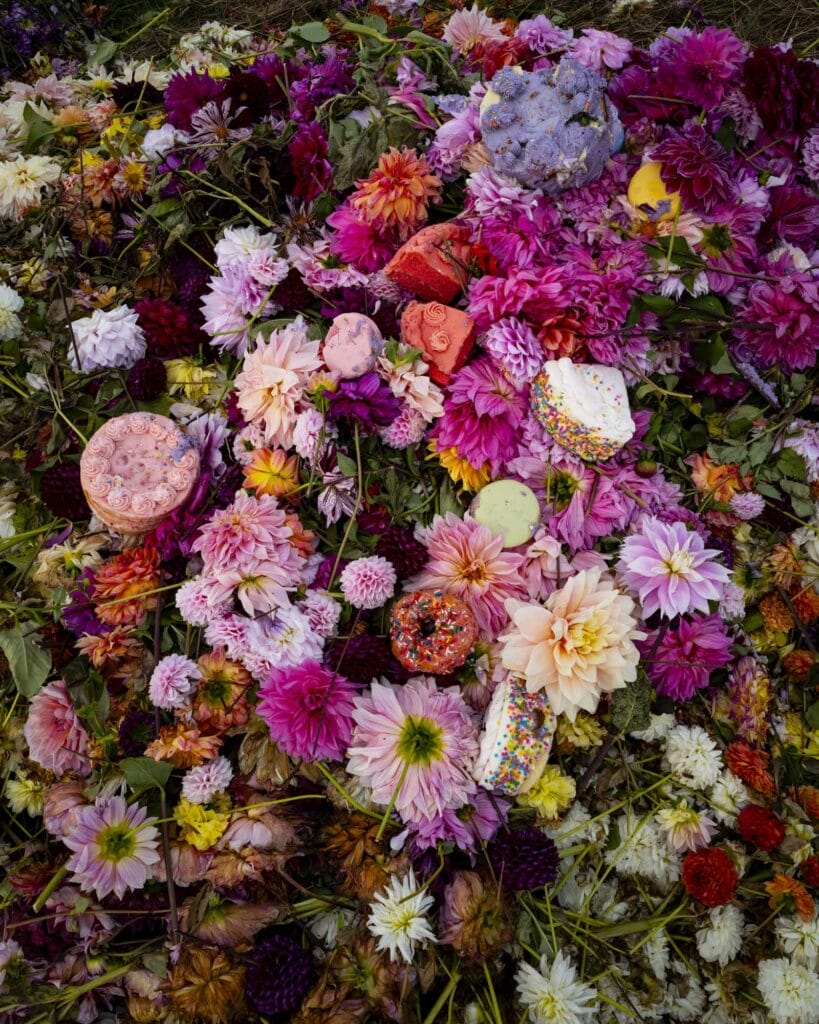
This is best exemplified in Compost & Cake, Rockport, Maine (2024). A bombastic explosion of magenta, peach, coral and lavender jumps out of the frame. This riotous mix of highly-saturated colors reveals itself to be a mountain of discarded flowers, the underlying layers seen at the edges of the composition visibly wilting. Further still, closer examination reveals that this is not only a pile of flora but of confectionaries as well — slices of cake and donuts interspersed with bouquets. Each layer of the composition that was revealed overturned the impression I was previously forming of the artwork.
This quality of quiet rebellion pervades Cig Harvey’s exhibition as the use of color both defines and defies in each artwork. Walking through this exhibition, I would encourage you to make three laps. You might be surprised by what you see on subsequent viewings. Emerald Drifters will remain on view at Jackson Fine Art through June 28.
::

Leia Genis is a trans artist and writer currently based in Atlanta. Her writing has been published in Hyperallergic, Frieze, Burnaway, Art Papers and Number: Inc. magazine. Genis is a graduate of the Savannah College of Art and Design and is also an avid cyclist with a competition history at the national level.
Credit: Source link