When people think of militaria, they usually focus on the Civil War. When collectors focus on World War II, they are often most interested in the European theatre, especially American and German equipment. However, the Far East saw a drawn-out and bloody conflict of its own. With a rising middle class in China and a fresh willingness to examine the nation’s history, new markets are opening up in the country.
World War II is the most popular period for military collectors. In East Asia, the Japanese fought major campaigns against the Chinese, British, and Americans until 1945. Military equipment flooded the region, and much of it still survives intact, offering a wealth of opportunity for the modern collector.
Japan
The katana is the most famous weapon ever produced in Japan. Made famous by samurai, it is a slightly curved longsword designed primarily for slashing. Samurai wielding katanas were particularly devastating on pre-gunpowder battlefields. However, their effectiveness declined as modern military technologies were gradually introduced into Japan during the 19th century.
Thousands of katanas were mass-produced during World War II, and they are the ones that most often come up for auction. These are typically not true samurai swords but rather guntō or copies produced in factories for military use. In America, such was the mystique of the katana that many servicemen were desperate to come home with one. While thousands of katanas were acquired in battle against the Japanese, others were acquired at the end of the war when GIs and Marines occupied Japan and its former colonial territories.
Without provenance linking them to notable individuals, most mass-produced swords are not worth thousands, but occasionally, some very special military swords come on the market.
Despite being gruesome weapons, katanas are beautiful in their construction. World War II examples are readily available on the modern market, though provenance should always be obtained for high-value purchases.
One recent sale in May 2025 involved the katana presented to Yahachi Tanabe, captain of the Japanese submarine I-168. On June 6, 1942, at the battle of Midway, torpedoes fired by his sub sunk the already crippled American carrier Yorktown. Despite the battle itself being a catastrophic defeat for the Japanese Navy, Tanabe’s actions were lionized by the Japanese military, resulting in this honorary katana being gifted to him. The sword sold for nearly $50,000.
Other Japanese World War II weapons are also highly desirable in the collecting world. Two that always sell are the Type-100 SMG with its distinctive curved clip and the Nambu pistol (the Imperial Japanese equivalent of the German Luger). Particularly fine examples of each sold at Morphy’s in 2024. The Type-100 went for $84,000, and the Nambu went for $16,800. One factor that greatly increased the value of the Type-100 was that it was proven to have been “combat used.”
During World War II, Japan’s most famous and capable unit was the Special Naval Landing Force (SNLF). These troops were the Japanese equivalent of Marines. Anything associated with them sells for inflated prices due to scarcity—they were a relatively small and elite force. Even pieces of webbing fetch high prices.
The Japanese Navy was large before the attack on Pearl Harbor. Several items were picked up by souvenir hunters after the Japanese surrender. In January 2025, an incredible authenticated flag from the Japanese battleship Nagato sold for almost $20,000. She was the only Japanese battleship to survive the war, but was destroyed in a nuclear bomb test in 1946.
China
China had a rough time in World War II. Invaded by the Japanese and wracked with civil war, the nation was almost fully militarized from 1937. This means there was fertile ground for collecting a wide variety of military kit. Chiang Kai Shek’s Nationalists bore the brunt of the war against the Japanese. They used an eclectic mix of equipment from several nations.
There is a marked difference in global popularity between Japanese and Chinese World War II equipment. This is partly because China fielded larger armies, thus producing more equipment, but also because many military collectors find more allure in collecting pieces from the defeated side in a war. This trend can be seen in the high prices that Confederate gear sells for (as opposed to Union) and the Wehrmacht kit compared to Allied forces.
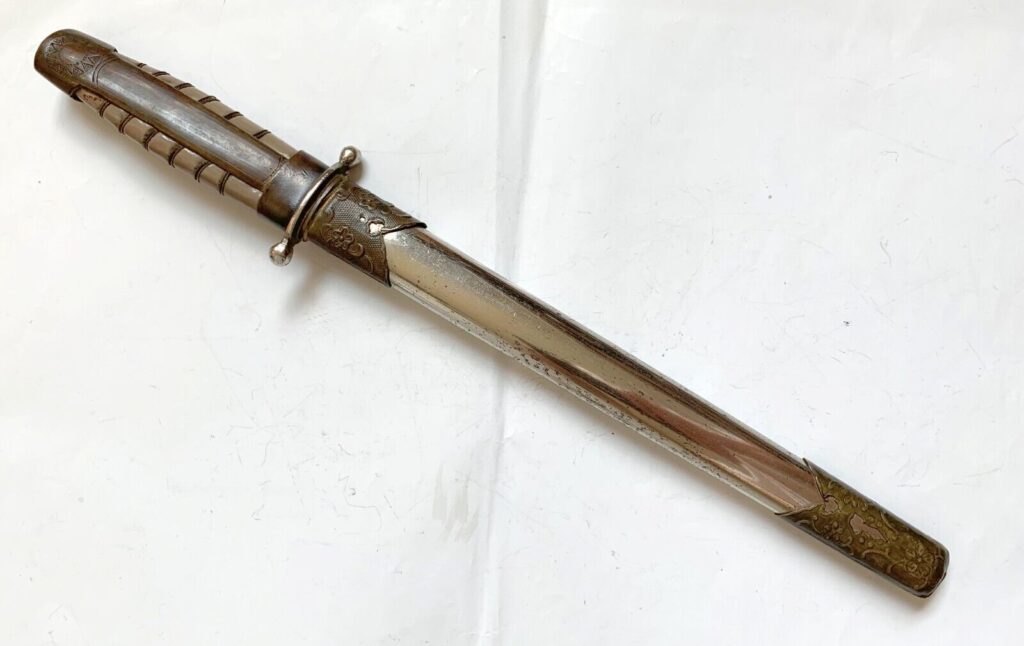
Nationalist officers’ daggers are very popular and plentiful. Some in reasonable condition can be bought for around $300. Most were issued to infantry officers, but some rarer Air Force daggers can go for up to $1000.
One famous military unit that fought in China during the war was the Flying Tigers, or First American Volunteer Group (AVG). These men were volunteer pilots from the US Army, Navy, and Marines who signed on with the Republic of China Air Force to fight the Japanese. Anything associated with this unique unit sells for high prices. A letter signed by the AVG commander, Claire Lee Chennault, fetched $500 in 2024.
Other Nations
One type of weapon linked inextricably to the Himalayan mountain kingdom of Nepal is the famous Gurkha Kukri knife. Gurkhas currently serve in the Indian and British armies, and their military traditions extend back centuries. The Gurkhas have resisted all attempts at colonization, even fighting the Victorian British to a standstill. Huge numbers of the knife are still produced in Nepal and elsewhere for tourist consumption. It is rare to find a kukri with provenance dating to World War II.
Some World War reproductions made in Nepal fetch colossal amounts. In 2022, an official repro blade went for close to $10,000.
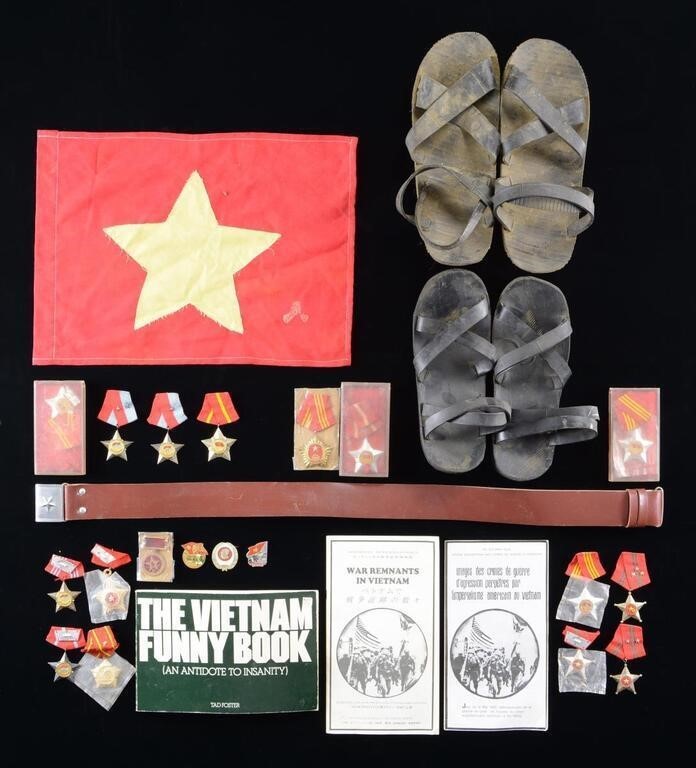
The Japanese occupied Vietnam during the war, and communist Vietnamese forces were active against the Japanese from 1940. These forces later morphed into the Vietminh, then the Vietcong and North Vietnamese Army. While World War II Vietnamese equipment is rare, communist kit from the later Vietnam War is popular in the militaria community.
These items most often come in the form of captured battle flags, helmets, and occasionally medals, and are usually sold as part of small collections. Much of this equipment dates from the 1940s, as Communist forces had uneven logistics, so they had to use (and re-use) every piece of kit. Collections of authentic gear can sell for many thousands of dollars, where provenance can be shown.
Final Thoughts
It is time for militaria collectors and sellers to re-evaluate the East Asian market. For many decades, the communist rulers of China did not encourage their population to learn their history. In recent years, this has changed, and narratives of the Japanese invasion are now taught in schools. A surging middle class with higher disposable income means Japanese, Nationalist, and Communist World War II equipment will have an increasingly large market in the region.
Matthew Doherty is a writer, editor, and teacher specializing in all things history-related. His work has been published in the UK Defence Journal, the Small Wars Journal, and The Collector. He holds an MSc from the University of Edinburgh and a BA from the University of Leeds. In his spare time, he also writes science fiction stories.
WorthPoint—Discover. Value. Preserve.
Credit: Source link