Before electricity, manual fanning was the only way to create a cooling airflow during sweltering summer days. Whether you did it yourself with a stylish hand fan or commanded someone to swish giant palm leaves over you, it was a weary way to get some relief.
However, as electricity became available across North America in the 1880s, and before central air conditioning became the norm, creating a nice breeze was much easier after an American engineer invented the first electric fan to circulate cool air.
From that first fan that spun wedge-shaped brass blades to a Vornado table fan with its mid-century aesthetic, electric fans were once the main staples of beating the heat. Whether used for utilitarian purposes or as decorative objects, antique and vintage fans today are hot commodities for collectors, who value them for their history, craftsmanship, and artful designs.
A BRIEF HISTORY
American electrical engineer Schuyler Skaats Wheeler is credited with inventing the first electric fan in 1882. The experimental work of Thomas Edison and Nikola Tesla inspired Wheeler to make a simple desk-top fan by attaching a two-bladed propeller to a small electric motor. Curtis & Crocker Electric Motor Company produced the fan in 1889.
These early fans had exposed electrical connections, which could cause shocks if touched, even when the fan wasn’t operating. Not only that, but the blades were exposed, so there was the potential danger of people slicing their hands if they got too close. Protective cages were later added around the blades as a safety measure.
Edison’s company, Edison Manufacturing, also produced electric fans from around 1885 to 1911, some of the rarest and most valuable today.
In the early 20th century, Emerson Electric, General Electric, Robbins & Myers, Westinghouse, and other American companies started mass-producing electric table fans for household use, including oscillating models. Featuring six wedge-shaped blades similar to a windmill’s structure, they were usually made of brass, iron, and steel, were heavy, and had protective wire cages around exposed blades. The fans also had an industrial design, with many having embossed logos and decorative details.
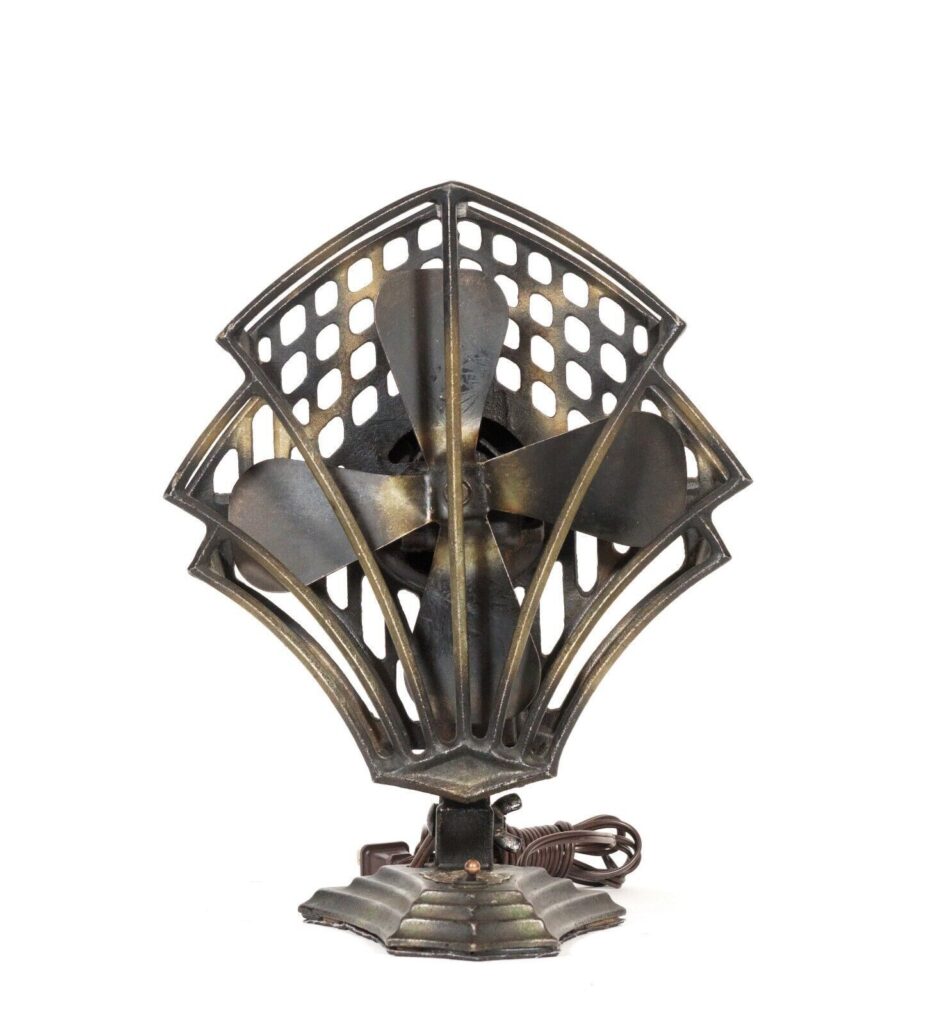
Manufacturers began developing different blade designs as technology advanced and competition increased by the 1920s. To help make fans quieter, General Electric introduced overlapping blades, and other designers quickly adapted this innovation to different forms, including Emerson designer Jane Evans, who created the Emerson Silver Swan. Manufactured beginning in 1932, the Swan’s silvery aluminum blades mimic the graceful profile of the bird, and the fan is one of the standout designs of the art deco era.
By the 1950s, fans featured plastic components and were made in typical mid-century styles and colors. A notable and fun space-age design was a table fan by the Fitzgerald Manufacturing Company, reminiscent of a futuristic rocketship or torpedo.
With the advent of air conditioning in the 1960s, the global demand for electric fans dwindled, though they did remain an efficient and economical way to cool down.
WHAT TO LOOK FOR
Most collectors prefer antique and vintage fans dating from the 1960s and before. Because these fans were built to last, there are a variety of forms to choose from today, including ceiling, floor, and table models, and an array of styles, whether you prefer elegant art deco designs or examples from the mid-century with whimsical space-age flair.
Look for fans made by major companies like Emerson, General Electric, Robbins & Myers, and Westinghouse, as they produced attractive models of good quality, with hand-wired motors, solid blades made of brass or steel, and durable cast-iron bases. Fans made by these companies are among the most sought-after and valuable, especially Emerson’s models.
Aside from looks and builds, the best buys will be fans that also still have their original enamel or paint finishes, intact nameplates or decals that include the serial and model numbers, oscillate properly, and are free from missing parts, rust, or frayed wiring, unless you plan to restore them.
DESIRABLE FANS AND VALUES
Antique and vintage fans can be found for $5 to thousands of dollars. Values are influenced by rarity, materials, condition, and overall design.
Early fans with brass blades are highly prized, especially ones made by Edison’s company, which are super rare. According to listings in WorthPoint’s Price Guide, these fans have been the top sellers over the last three years, including this one from 1894 that sold in June 2025 for $25,000. A handful of other Edison fans have sold between $2,650 and $12,600 for just the motor.
Another revered early fan is the General Electric desk model called “the Pancake” by collectors due to its large diameter but thin motor. These were produced from 1894 through 1908 in sizes ranging from 10 to 16 inches. Database listings show that most of these have sold between $500 and $6,000 over the last three years for a rare and restored wall-mounted example.
Collectors also like fans from the 1920s and ’30s for their classic art deco designs and fun forms. The popular Emerson Silver Swan fans have sold between $100 and $700 over the last three years, including this pedestal model that sold for $650 in 2023, even with a non-working motor.
Other valuable designs from the 1930s are ceiling fans in the form of airplanes, inspired by Charles Lindbergh’s 1927 flight from New York to Paris. These were made by various companies, including Dallas Engineering Corporation and Kennedy Machine and Brass Works, and have fetched between $2,400 and $5,900 for this Kennedy example that sold in 2024.
Among the sought-after mid-century designs are hassock floor fans made in different styles and by various companies, including Vornado. These fans can generate air in every direction and also double as stools. These models have sold between $25 and $425.

Fans with inventive features can also be valuable, like Singer’s Ribbonaire, manufactured in the 1930s. These fans have blades made of fabric instead of metal and were marketed as providing an equivalent breeze without fear of gashed fingers. With their streamlined Bakelite bodies, Ribbonaires were fashionable and safer substitutes for regular table fans. These have sold between $50 and $795.
Antique and vintage fans offer more than just a way to keep cool. They are tangible links to the past and mechanical wonders with timeless appeal and breezy charm.
Adina K. Francis has been a writer and editor in the antiques and collectibles field for more than twenty years. She has a bit of an obsession with the Victorians and thinks that dogs are one of life’s greatest gifts.
WorthPoint—Discover. Value. Preserve.
Credit: Source link