When researching Victorian mourning practices, I saw a photo of beautiful little glass bottles labeled “tear catchers.” The accompanying information said they were so named because grieving women would weep into them.
Since the Victorians elevated mourning to an art form, I readily believed it and was captivated by the thought that the bottles were used to capture sorrow.
But when I delved further, I learned that the story behind them is just a myth. I can’t remember a time when something in the antiques and collectibles world disappointed me more than that news.
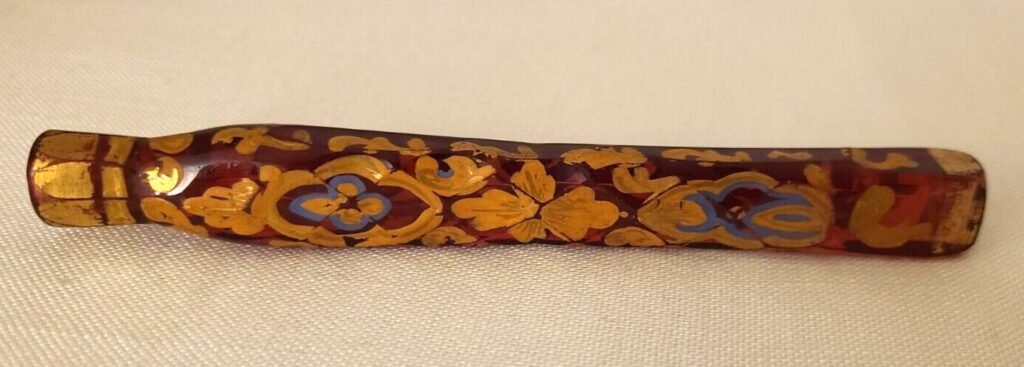
I’m sorry if this debunking disheartens you, too, but in actuality, these hand-blown glass bottles are “throwaway” scent bottles” that held perfume, not tears, and were meant to be discarded after women transferred their contents into decanters they had at home.
While there is no concrete evidence that they caught tears, what can’t be debunked is the fact that these bottles charm collectors.
BUSTING THE TEAR-CATCHER MYTH
Because the Victorians had elaborate grieving rituals, including weaving the hair of their deceased loved ones into jewelry, it’s easy to see why the myth of crying into delicate glass bottles has persisted.
According to legend, tear catchers, also called lachrymatory bottles, were used to measure grieving time in the 19th century in England and in America during the Civil War. The mourning period was over once the tears caught in the bottles evaporated.
It’s a lovely, sentimental story, but historians and other experts say there is no evidence that this ever happened.
In a 2017 article at Atlas Obscura, perfume historian Grace Elizabeth Hummel said the myth likely began with early scholars, who romantically labeled the small glass bottles that archaeologists often found in Greek and Roman tombs as lachrymatories or tear bottles, but chemical tests conducted by scientists disproved that theory.
However, through historical accident and false, yet successful, advertising since then, the “tear catcher” term has stuck.
Perfumer and researcher Nuri McBride, who writes about fragrance and death rituals at Death/Scent, said in a 2021 story that she and her colleagues also dispute this myth.
“These bottles are presented sometimes as Victorian or Civil War tear catchers, used to hold the tears of lost love from a bygone and sentimental age. I’m sorry to say these are not romantic mourning keepsakes. These are throwaway bottles aka, disposable perfume bottles. They are the empty Lip Smacker tubes of the 19th century,” McBride said.
She said she and the twenty colleagues and journalists she has consulted with have never found any historical source that says throwaway bottles functioned as tear catchers or had any other sentimental purpose.
A 2024 post on the Wearing History Blog also said there were no references to tear-catcher bottles in Victorian records at online newspaper archives.
McBride said she found the first connections between Victorian bottles and mourning in a few books from the 1990s.
This makes sense, considering there was a big revival of all things Victorian during that decade. Lachrymatories are also mentioned in the 1996 novel Divine Secrets of the Ya-Ya Sisterhood.
As far as the story that has spread on the internet for decades, McBride said that while she can’t definitively prove it originated from the website, Lachrymatory.com, information presented there since 2002 has had an impact.
Once a good story gains momentum on the internet, it takes on a life of its own with the help of people who want to believe it’s true.
As Christian Harding, one-time owner of The Belfry oddities store in Seattle, Washington, told Atlas Obscura, even when he explained the proper use of these decorative bottles to collectors, many didn’t want to accept it, and others just didn’t care.
Even McBride conceded that there’s a possibility a Victorian woman somewhere might have tried capturing her tears in a bottle, but that doesn’t make it a standard custom.
TEARS OR NOT, THE BOTTLES ARE HIGHLY COLLECTIBLE
Despite being inaccurate, “Victorian tear catcher” and “lachrymatory bottle” are commonly accepted terms in the collecting community for throwaway scent bottles, as not everyone is aware of the misconception. When looking through WorthPoint’s Price Guide, far more listings come up under those two search terms than “throwaway scent bottle.”
To further confuse things, “laydown” perfume bottles, also prized collectibles, are often interchanged with throwaways. But laydowns are larger, generally made of cut glass or crystal, are of higher quality, and bring higher prices, especially examples made by famous companies. They also have silver-plated caps, usually screw-on, that seal tightly. They are called laydowns because they were meant to be displayed on a vanity, and don’t have a flat bottom to stand upright.
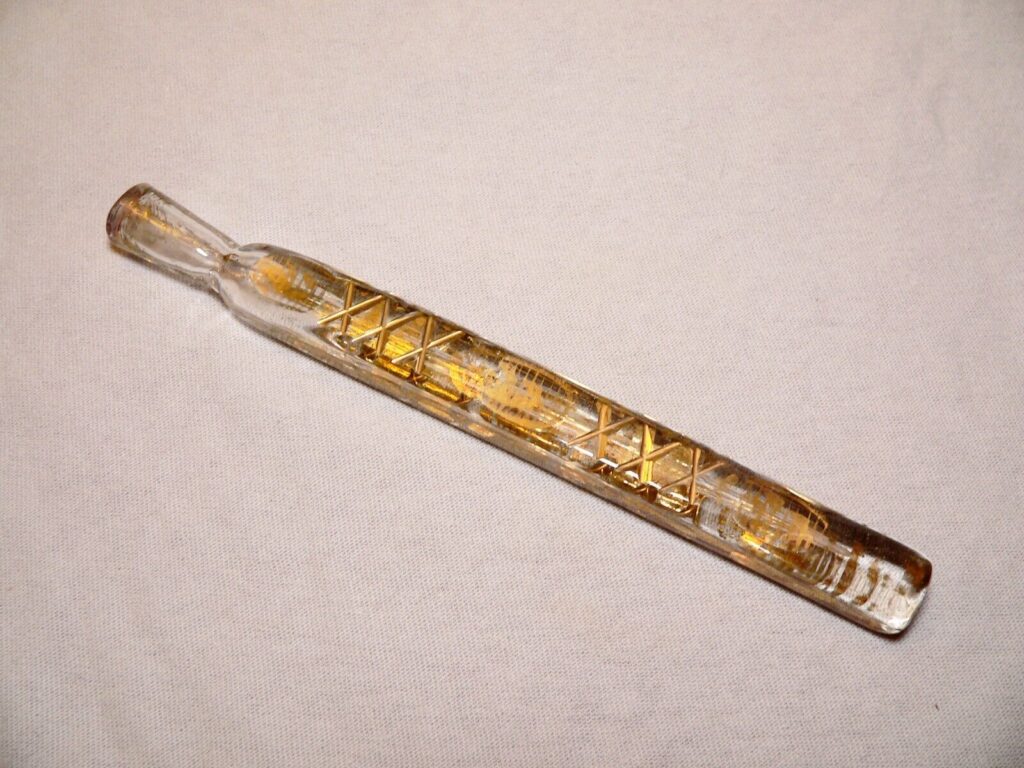
Hand-blown throwaway bottles, also known as attar bottles and Oxford lavenders, are 5 to 8 inches long and generally have flat bottoms and glass stoppers that often fit poorly. They were mostly produced in Bohemia and England beginning in the late 18th century, after perfumes became readily available to everyone, not just the wealthy. Most surviving examples are from the 1850s to 1910.
Chemists and perfumers used them to dole out samples, and since they were cheaply made for the masses, they were typically tossed once a woman emptied the perfume sample into a fancier decanter.
Given how beautiful and elaborately decorated some of these bottles are, it’s hard to believe they were treated like garbage. Luckily for collectors, many have survived and can be found in different colors and designs.
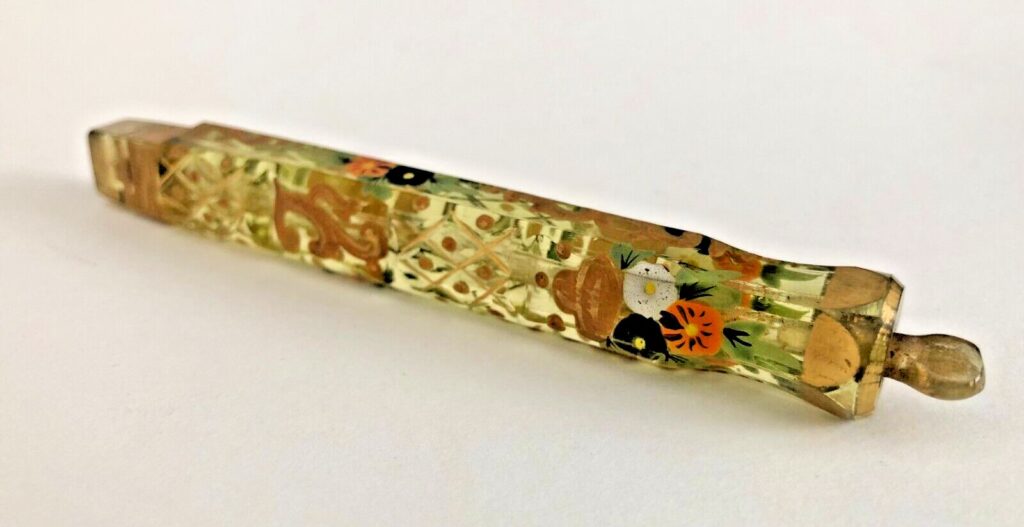
Commonly made of clear glass, throwaway bottles were also made in amber, cobalt blue, green, and other colors. Some bottles are also decorated with bright enamels or rich gilding and can have various hand-painted designs.
According to prices recorded in WorthPoint’s database, bottles have sold over the last several years between $10 for a clear example with gold flashing to a hair under $2,000 for an instant collection of 43; most have sold in the $50 to $100 range.
Not surprisingly, the more elaborately designed bottles with enamel decorations and hand-painted embellishments are the most valuable, as are pieces made in colored glass. These bottles were likely handed out by high-end perfumers and other retailers and also produced by famous glassworks, like Moser Glass, which is known for its quality pieces that are favorites with collectors. This Moser blue bottle with an enameled floral decoration sold for $350 in 2024.
Whether you want to believe the story behind Victorian tear catchers is fact or fiction is up to you. But whichever side you take, one thing is certain: These bottles are endearing little collectibles with fascinating folklore.
Adina K. Francis has been a writer and editor in the antiques and collectibles field for more than twenty years. She has a bit of an obsession with the Victorians and thinks that dogs are one of life’s greatest gifts.
WorthPoint—Discover. Value. Preserve.
Credit: Source link