Close Menu
  • Home
  • Art News
  • Cinema
  • Antiques
  • Jewellery
  • Crypto News
Facebook X (Twitter) Instagram
  • Home
  • Art News
  • Cinema
  • Antiques
  • Jewellery
  • Crypto News
Facebook X (Twitter) Instagram Pinterest YouTube
AMG
  • Home
  • Art News
  • Cinema
  • Antiques
  • Jewellery
  • Crypto News
AMG
Home » Ancient Jewels and Unique Goldsmithing Masterpieces
Ancient Jewels and Unique Goldsmithing Masterpieces

Ancient Jewels and Unique Goldsmithing Masterpieces

April 28, 2025No Comments9 Mins Read Jewellery
Share
Facebook Twitter LinkedIn Pinterest Email

Ancient necklaces, rings that enclose secrets, hairpins, gold belts, and inlaid bracelets: these are just some of the jewels preserved at the Poldi Pezzoli Museum, in Milan. It stands in the neighborhood called “Fashion Quadrilateral,” where the major couture designers have their showrooms. It is easy, therefore, to understand how these masterpieces of goldsmithing from the past influence modern jewelry creators in the city of fashion.

Gian Giacomo Poldi Pezzoli, a very generous man
The collection of ancient jewelry is one of the many collections in this museum, named after its founder, Gian Giacomo Poldi Pezzoli. The nobleman converted his “special apartment” to house all the treasures he had collected during his lifetime, among them weapons, clocks, paintings, statues, lace, and furniture. Furthermore, the museum holds over 300 pieces of goldsmithing, ranging from the 7th century BCE to after the founder’s death.

In 1879, Poldi Pezzoli passed away, leaving everything to the community. After the museum’s founding, many art and jewelry lovers continued to leave their collections to it.

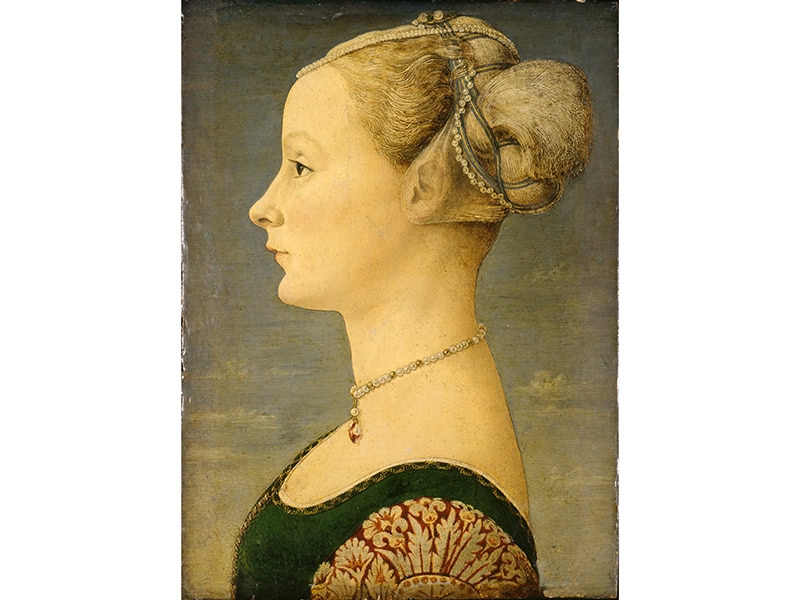
Pietro Pollaio, Portrait of a Lady, circa 1470, tempera and oil paint, photo: @Museo Poldi Pezzoli. This painting is the symbol of the Poldi Pezzoli Museum.

Jewels are even in the symbol of the museum
The most famous painting in the Poldi Pezzoli Museum is Portrait of a Lady, by Piero del Pollaiolo. Executed between 1470 and 1475, it depicts a noblewoman wearing a precious necklace rich in symbols. The white of the pearls evokes purity and virginity, the ruby in the pendant, romantic passion. In her hair, the woman has a string of small pearls, perfectly linked to each other. This demonstrates how well the painter knew the goldsmithing art of his time.

The jewelry collection is divided into four sections

  • Enamels. These were very fashionable in the 19th century
  • Ecclesiastical goldsmithing. This category includes crosses, cups, and chalices from Italian and foreign churches and convents
  • Objets de vertu . The small luxury items for personal care comprise things such as perfume bottles, needle cases, cutlery, and many other trinkets
  • Personal jewelry. In addition to necklaces belonging to the founder’s mother, there are precious items purchased throughout Europe. Poldi Pezzoli, in fact, despite his love for the Renaissance, chose jewelry from all eras for his collection, always seeking the highest artistic expression in every acquired object
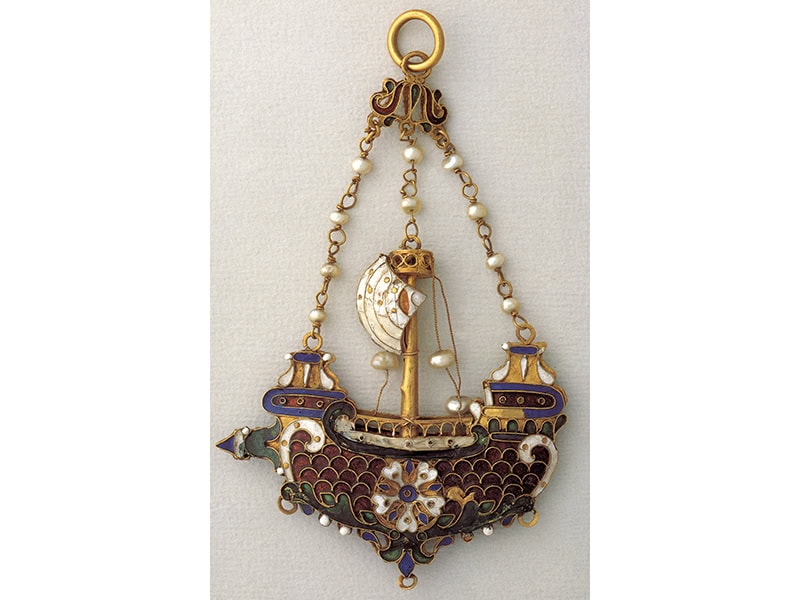
Pendant with Caravel, end of the 16th century, gold, pearls, enamel, 3 ⅜ inches (86 mm) long, 10.1g, photo: @Museo Poldi Pezzoli. Both faces of the pendant are enameled.

Renaissance pendants in the shape of ships
Among the personal jewelry, the pendant depicting a Venetian caravel from the late 16th century stands out. The tiny ship is made of gold, pearls, and enamels. Another one represents the Invincible Armada. It appears that Elizabeth I gave it to one of her commanders. The pendant consists of two oval elements connected to each other, decorated with polychrome enamels and a frame with 43 rubies. These were hung on necklaces, but could also be used to adorn the hair, or as a pendant on bracelets.
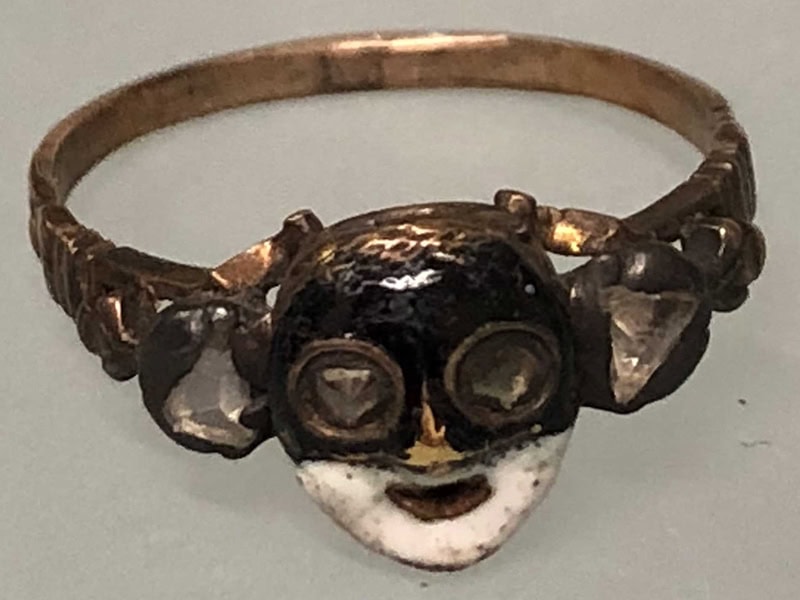
Venetian Ring, 1700–1725, gold, enamel, diamonds, photo: @Museo Poldi Pezzoli. The ring can be opened, and inside it hides a small heart in red enamel.

Rings that enclose secrets … not always nice ones!
There are about 50 rings, each more beautiful than the other. Some are truly unique, such as the one shaped like a skull or the one shaped like a Carnival mask. The mask has diamond eyes and can be opened. The ring dates back to 1725 and was probably made in Venice, the birthplace of Casanova. Is this why a small red enamel heart is hidden inside?
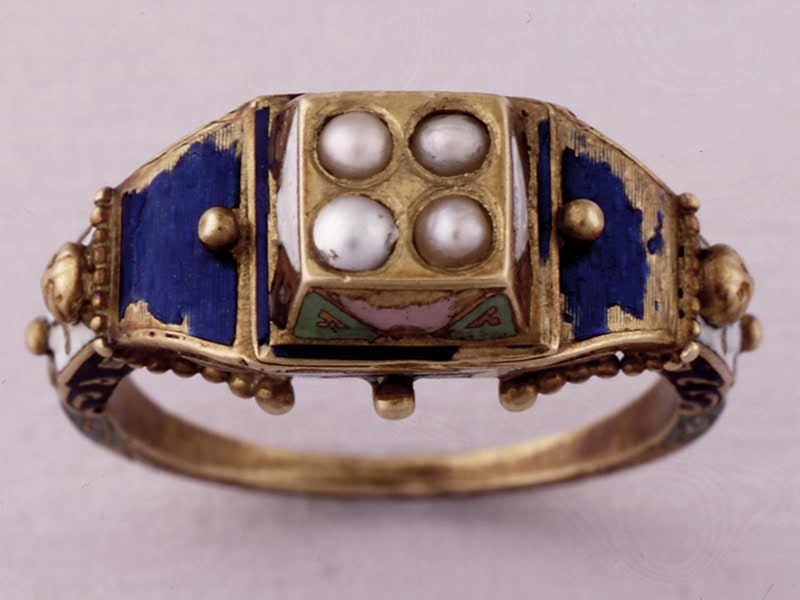
Openable Ring, 1550–1575, gold, pearls, enamel, ¾ inches (18 mm) in diameter, photo: @Museo Poldi Pezzoli. The ring hid poison inside.

Another incredible ring dates back to 1550. This one, however, does not contain messages of love. Its small casket, with four pearls on top, was used to conceal poison. The jewel opens thanks to an almost invisible hinge. This technical solution would be patented only centuries later by the jeweler and goldsmith Peter Carl Fabergé for his famous snuffboxes.
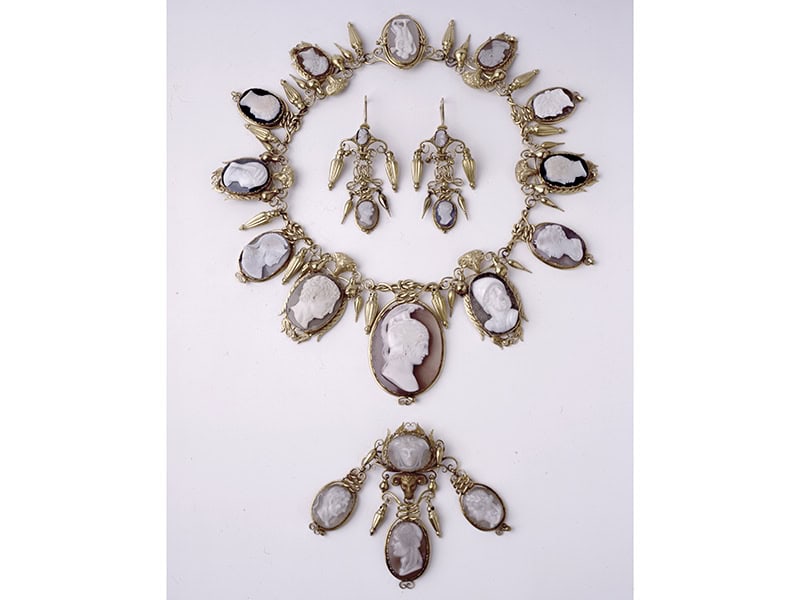
Fortunato Pio Castellani, Necklace and Earrings, 1794–1865, opra, agate, photo: @Museo Poldi Pezzoli. Fortunato Pio Castellani was one of the most important goldsmiths of his time. These pieces were owned by Rosina Trivulzio, the mother of the museum's founder.
Fortunato Pio Castellani, Necklace and Earrings, 1825–1830, opra, agate, photo: @Museo Poldi Pezzoli. Fortunato Pio Castellani was one of the most important goldsmiths of his time. These pieces were owned by Rosina Trivulzio, the mother of the museum’s founder.

Parures inspired by ancient Greece
It is said that Gian Giacomo Poldi Pezzoli was a “mamma’s boy” to the extent that after the death of his beloved mother, he had a bust made of her. Every day, he would place the jewelry worn by the deceased on the statue. Among these were certainly the parures displayed in the collection. There’s the one created by the famous goldsmith Fortunato Pio Castellani (1794–1865). Castellani was known for imitating Greek or Etruscan jewelry. The necklace shown above is composed of 12 large oval cameos, in gold and agate. The brooch has four smaller ones. The earrings have two even smaller cameos. All of them depict images from Greek mythology, such as the heads of “Athena the Virgin,” Cupid and Psyche, or Medusa.
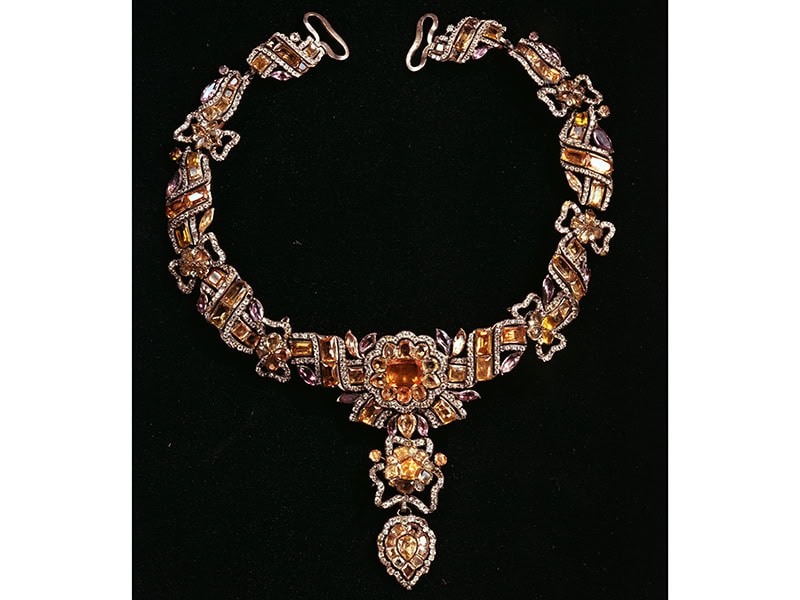
Detachable Necklace, mid-18th century, silver, topaz, amethyst, zircon, photo: @Museo Poldi Pezzoli. The necklace is made of 17 detachable pieces. It could be dismantled, and its pieces were sewn onto clothes or used as brooches or to adorn hairstyles.

Detachable necklaces for functional elegance
In the 18th century, the Age of Enlightenment, gemstones were no longer used for their magical and symbolic qualities as they were in the Middle Ages. Therefore, even in the case of the necklace shown above, the choice to use silver, topaz, amethysts, and zircons was certainly dictated by the desire to create a pleasing combination of colors, perhaps linked to the attire for which the jewelry was intended. The necklace is made up of 17 detachable pieces. The pendant could also be used as a brooch or a hairpin. The side parts, on the other hand, could be turned into two bracelets. This demonstrates how in jewelry functionality can blend with elegance.
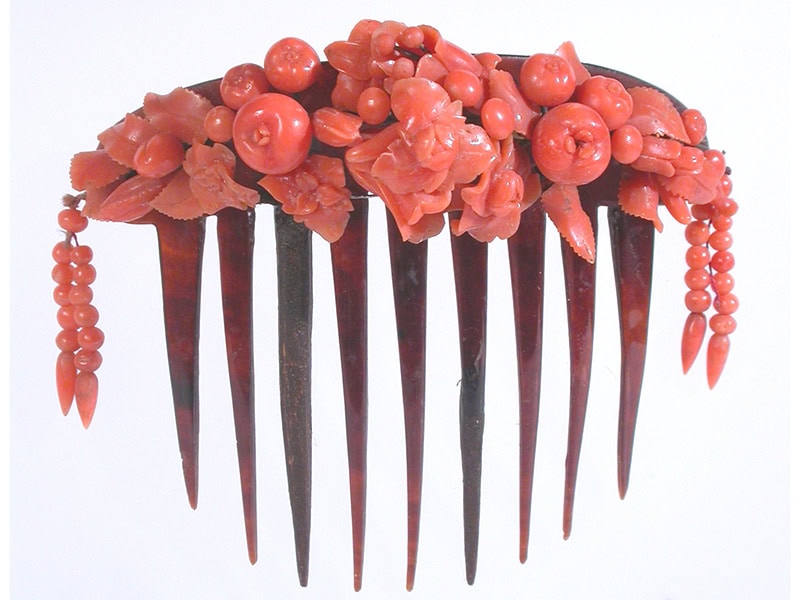
Coral Comb, 1865, tortoiseshell, coral, photo: @Museo Poldi Pezzoli. The comb is made of tortoiseshell and is adorned with a garland of flowers and fruit made of coral. It is part of an evening set that also contains a coral necklace, bracelet, and earrings. It was made by jewelers from Torre del Greco, a town in the province of Naples, where this material is still worked.

Coral creations
Many items in the collection are made of Neapolitan coral, including this small comb in tortoiseshell from around 1865. It was used to embellish hairstyles. Thanks to the coral inlay, depicting a garland of fruit and flowers, it becomes a true jewel for display in the hair. The small comb is part of a parure, which also includes a necklace, earrings, brooch, and bracelet. The “flowers and fruits” technique is typical of Neapolitan coral manufacturing, particularly in Torre del Greco from the 15th century.
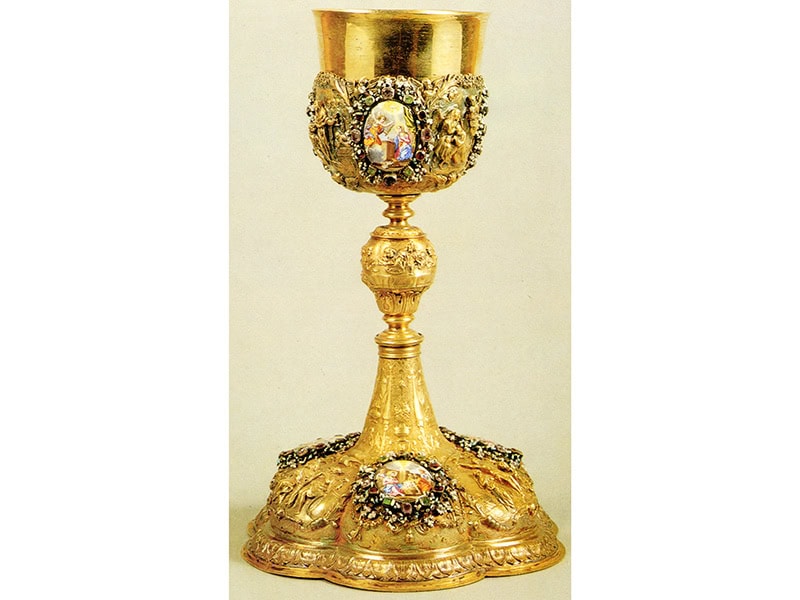
Hans Jacob II Läublin, Chalice, 1710, gilded silver, enamels, painted enamel on copper, amethysts, rubies, emeralds, 11 ⅜ inches (290 mm) tall, 810g, photo: @Museo Poldi Pezzoli. Hans Jacob II Läublin was a goldsmith who specialized in the production of sacred jewels.

Religious goldsmithing: from chalices to crosses
During the rule of Napoleon Bonaparte, many religious orders were suppressed. As a result, church properties were sold. However, for centuries, they had been perfectly preserved for use in ceremonies. As evidence, one need only look at the sumptuous Baroque gold and enamel chalice, a work by the Swiss goldsmith Hans Jacob II Läublin, marked with his initials, “JHL. ” The goldsmith, who specialized in these religious objects, was commissioned by the Swiss abbot Bonifatius II zur Gilgen (1664–1724). This is evidenced by the family crest, a shield with three white lilies and a miter—the abbot’s hat—atop an angel’s head.
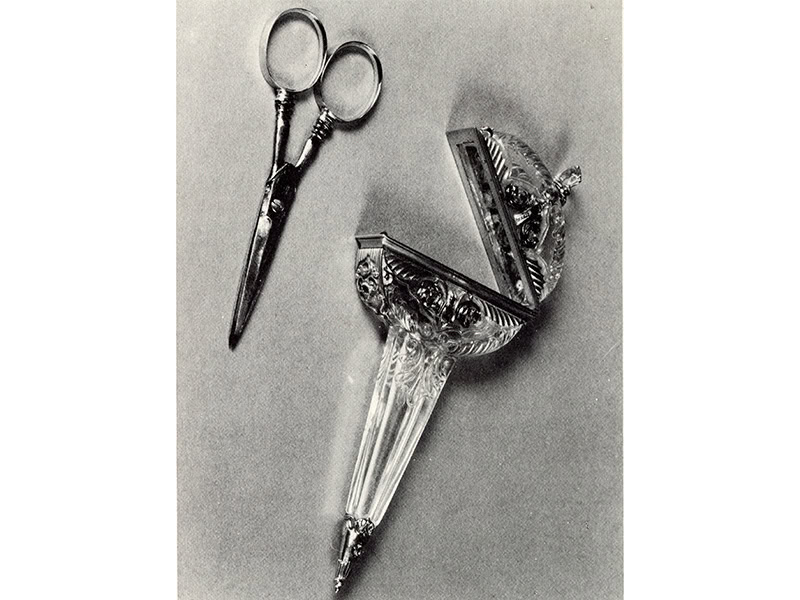
Scissors with Double Case, 17th century, copper, steel, gold, rock crystal, diamonds, rubies, leather, photo: @Museo Poldi Pezzoli

When luxury transforms everyday objects
Jewelers and goldsmiths produced objects of virtue, namely small personal care jewels, in metals and gemstones. This is the case of the case for small scissors from the 17th century, produced in rock crystal, diamonds, and rubies.
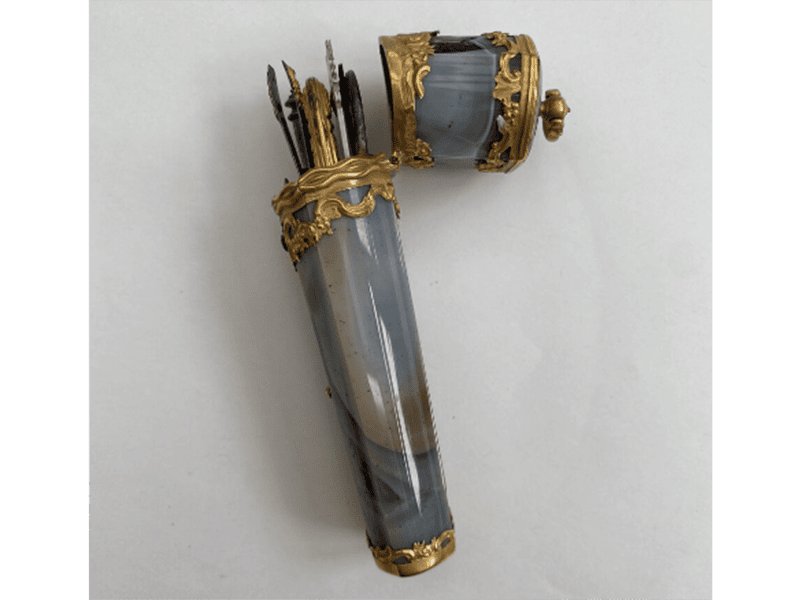
Cosmetic Bag for Ladies, 18th century, gold, silver, agate, ivory, copper, wood, diamond, 4 ¾ inches (120 mm) long, 87.5g, photo: @Museo Poldi Pezzoli. The case has a copper structure and a lining made from two pieces of agate. It is made of gold, silver, agate, ivory, copper, wood, diamond. It contains six pieces, all decorated in gold or engraved.
Cosmetic Bag for Ladies, 18th century, gold, silver, agate, ivory, copper, wood, diamond, 4 ¾ inches (120 mm) long, 87.5g, photo: @Museo Poldi Pezzoli. The case has a copper structure and a lining made from two pieces of agate. It contains six pieces, all decorated in gold or engraved.

Admire the ladies’ nécessaire in gold, silver, agate, ivory, copper, wood, and diamond. It contains six tools, including a small razor, tiny scissors, and a nail file, the latter in gold.
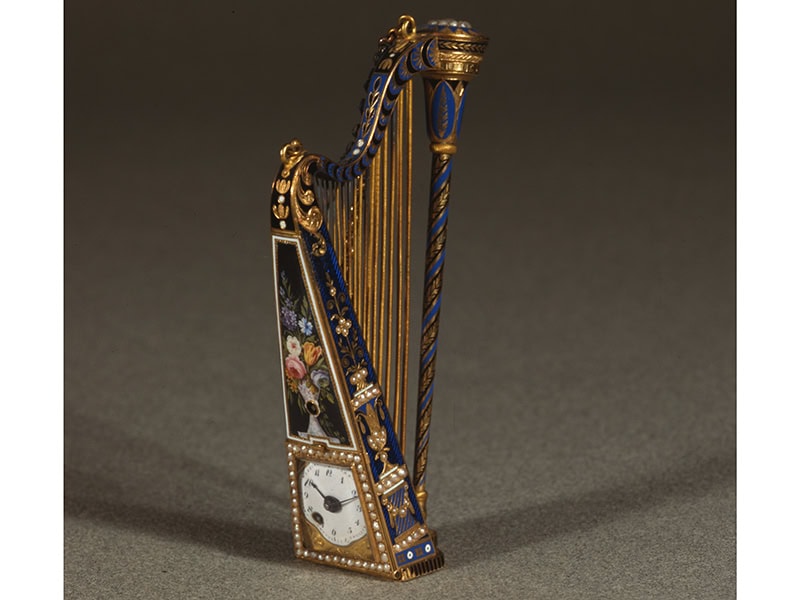
Harp-shaped Clock, 1800–1825, gold, enamel, beads, diamonds, 3 ⅛ inches (81 mm) tall, photo: @Museo Poldi Pezzoli. The clock, made of solid gold, is decorated in translucent enamel with floral motifs. It is adorned with beads and diamonds. The production of “fancy” jewelry watches is typical of Geneva.

Timepieces that are masterpieces
Ancient watches have a space all to themselves inside the museum. However, many of them are real jewels to be displayed, like pendants hanging on a necklace. This clock, shaped like a small harp, in gold, pearls, diamonds, and enamels, was made in Switzerland at the beginning of the 19th century.

It still enchants our eyes, as do the many pieces in the Poldi Pezzoli Museum. Don’t miss this treasure when you’re in Milan.

The Poldi Pezzoli Museum is at Via Manzoni 12, in Milan.  To visit its website, click here.

We welcome your comments on our publishing, and will publish letters that engage with our articles in a thoughtful and polite manner. Please submit letters to the editor electronically; do so here.

© 2025 Art Jewelry Forum. All rights reserved. Content may not be reproduced in whole or in part without permission. For reprint permission, contact info (at) artjewelryforum (dot) org

Credit: Source link

Share. Facebook Twitter Pinterest LinkedIn Tumblr Email

ANGadmin

Related Posts

Jewelry Collection Story – Hannah of @georgie-the-magpie – Gem Gossip

July 20, 2025

Jewelry Collection Story – Amie of @roguevintagejewels – Gem Gossip

July 9, 2025

Necklace Layering for Dummies (Stylish Dummies) – Gem Gossip

July 8, 2025

Defiant jewelry: talismans of strength.

July 8, 2025
Add A Comment

Comments are closed.

Editors Picks

Bitcoin, Ethereum, XRP Price Prediction for Next Week (28th July

July 27, 2025

Should Fine Artists Embrace Digital Art or Fear It? The Untold Revolutionary Benefit

July 26, 2025

Are Whales Signaling the Next XRP Rally With 130M Tokens Bought in 24 Hours?

July 26, 2025

Weekly Crypto Roundup: Ripple CEO Selling Erodes Trust While Unilabs (UNIL) Leads July Demand

July 26, 2025
About

Angelamaingallery is an online news portal that aims to share the latest Art news, Antiques, Jewellery, Cinema, Crypto
and much more stuff.

Facebook X (Twitter) Instagram Pinterest YouTube
Top Insights

Epergnes Command the Center of Attention

April 22, 2025

BTC On-Chain Metrics at Bull-Bear Boundary – What’s Next for Bitcoin?

February 27, 2025

Dara Birnbaum, video artist who remixed mass media, has died at 78.

May 5, 2025
Facebook X (Twitter) Instagram Pinterest YouTube
  • Contact Us
  • Disclaimer
  • Privacy Policy
  • Terms of Use
  • DMCA

Type above and press Enter to search. Press Esc to cancel.

  • bitcoinBitcoin(BTC)$77,671.00-1.37%
  • ethereumEthereum(ETH)$2,304.53-3.68%
  • tetherTether(USDT)$1.000.00%
  • rippleXRP(XRP)$1.43-0.98%
  • binancecoinBNB(BNB)$634.32-1.64%
  • usd-coinUSDC(USDC)$1.00-0.01%
  • solanaSolana(SOL)$85.24-2.67%
  • tronTRON(TRX)$0.328844-0.01%
  • Figure HelocFigure Heloc(FIGR_HELOC)$1.041.65%
  • dogecoinDogecoin(DOGE)$0.095891-1.05%
  • whitebitWhiteBIT Coin(WBT)$54.97-2.09%
  • USDSUSDS(USDS)$1.000.00%
  • HyperliquidHyperliquid(HYPE)$41.220.24%
  • leo-tokenLEO Token(LEO)$10.280.51%
  • bitcoin-cashBitcoin Cash(BCH)$456.06-1.80%
  • cardanoCardano(ADA)$0.245902-2.81%
  • moneroMonero(XMR)$372.00-1.69%
  • chainlinkChainlink(LINK)$9.23-2.25%
  • stellarStellar(XLM)$0.175891-1.59%
  • CantonCanton(CC)$0.150182-1.74%
  • MemeCoreMemeCore(M)$4.270.06%
  • zcashZcash(ZEC)$329.241.39%
  • daiDai(DAI)$1.00-0.02%
  • USD1USD1(USD1)$1.00-0.04%
  • litecoinLitecoin(LTC)$55.35-1.43%
  • avalanche-2Avalanche(AVAX)$9.26-2.63%
  • Ethena USDeEthena USDe(USDE)$1.00-0.01%
  • hedera-hashgraphHedera(HBAR)$0.090063-2.17%
  • suiSui(SUI)$0.93-3.42%
  • shiba-inuShiba Inu(SHIB)$0.000006-2.37%
  • RainRain(RAIN)$0.007468-3.88%
  • paypal-usdPayPal USD(PYUSD)$1.000.00%
  • the-open-networkToncoin(TON)$1.35-1.72%
  • crypto-com-chainCronos(CRO)$0.069823-0.67%
  • Circle USYCCircle USYC(USYC)$1.12-0.09%
  • tether-goldTether Gold(XAUT)$4,687.00-0.78%
  • BlackRock USD Institutional Digital Liquidity FundBlackRock USD Institutional Digital Liquidity Fund(BUIDL)$1.000.00%
  • World Liberty FinancialWorld Liberty Financial(WLFI)$0.076973-3.13%
  • Global DollarGlobal Dollar(USDG)$1.000.00%
  • BittensorBittensor(TAO)$242.33-1.78%
  • pax-goldPAX Gold(PAXG)$4,689.11-0.85%
  • mantleMantle(MNT)$0.64-1.57%
  • uniswapUniswap(UNI)$3.24-4.87%
  • polkadotPolkadot(DOT)$1.22-5.21%
  • SkySky(SKY)$0.0851021.79%
  • nearNEAR Protocol(NEAR)$1.39-2.07%
  • Falcon USDFalcon USD(USDF)$1.00-0.11%
  • okbOKB(OKB)$83.52-1.75%
  • Pi NetworkPi Network(PI)$0.167196-1.24%
  • HTX DAOHTX DAO(HTX)$0.0000020.16%
  • AsterAster(ASTER)$0.67-2.33%
  • pepePepe(PEPE)$0.000004-3.49%
  • Janus Henderson Anemoy Treasury FundJanus Henderson Anemoy Treasury Fund(JTRSY)$1.100.01%
  • Ripple USDRipple USD(RLUSD)$1.00-0.03%
  • aaveAave(AAVE)$91.77-2.87%
  • usddUSDD(USDD)$1.000.00%
  • bitget-tokenBitget Token(BGB)$1.94-0.33%
  • internet-computerInternet Computer(ICP)$2.44-3.52%
  • Ondo US Dollar YieldOndo US Dollar Yield(USDY)$1.130.22%
  • BFUSDBFUSD(BFUSD)$1.000.01%
  • ethereum-classicEthereum Classic(ETC)$8.42-1.93%
  • OndoOndo(ONDO)$0.257745-2.96%
  • gatechain-tokenGate(GT)$7.34-1.41%
  • kucoin-sharesKuCoin(KCS)$8.36-2.56%
  • quant-networkQuant(QNT)$72.69-2.37%
  • MorphoMorpho(MORPHO)$1.89-2.40%
  • Pump.funPump.fun(PUMP)$0.001773-5.89%
  • United StablesUnited Stables(U)$1.00-0.03%
  • Spiko EU T-Bills Money Market FundSpiko EU T-Bills Money Market Fund(EUTBL)$1.23-0.13%
  • polygon-ecosystem-tokenPOL (ex-MATIC)(POL)$0.093693-0.66%
  • EthenaEthena(ENA)$0.108323-2.25%
  • cosmosCosmos Hub(ATOM)$1.87-0.69%
  • kaspaKaspa(KAS)$0.033796-2.61%
  • render-tokenRender(RENDER)$1.78-3.27%
  • algorandAlgorand(ALGO)$0.102505-1.47%
  • nexoNEXO(NEXO)$0.90-2.89%
  • worldcoin-wldWorldcoin(WLD)$0.258242-4.23%
  • Superstate Short Duration U.S. Government Securities Fund (USTB)Superstate Short Duration U.S. Government Securities Fund (USTB)(USTB)$11.060.01%
  • arbitrumArbitrum(ARB)$0.125608-4.63%
  • Blockchain CapitalBlockchain Capital(BCAP)$82.760.00%
  • aptosAptos(APT)$0.93-3.16%
  • justJUST(JST)$0.0830261.81%
  • filecoinFilecoin(FIL)$0.91-3.37%
  • flare-networksFlare(FLR)$0.007921-1.82%
  • Official TrumpOfficial Trump(TRUMP)$2.83-4.52%
  • ​​Stable​​Stable(STABLE)$0.02974911.80%
  • beldexBeldex(BDX)$0.0801200.35%
  • vechainVeChain(VET)$0.007175-1.34%
  • MidnightMidnight(NIGHT)$0.036420-2.21%
  • JupiterJupiter(JUP)$0.169826-3.70%
  • OUSGOUSG(OUSG)$115.010.01%
  • Provenance BlockchainProvenance Blockchain(HASH)$0.0104410.06%
  • xdce-crowd-saleXDC Network(XDC)$0.029705-3.54%
  • dexeDeXe(DEXE)$12.541.97%
  • GHOGHO(GHO)$1.000.00%
  • USDtbUSDtb(USDTB)$1.000.02%
  • Usual USDUsual USD(USD0)$1.00-0.02%
  • bonkBonk(BONK)$0.000006-3.92%
  • YLDSYLDS(YLDS)$1.00-0.01%
  • Pudgy PenguinsPudgy Penguins(PENGU)$0.008349-2.47%