On February 9, 2025, President Trump ordered the US Mint to discontinue production of the United States one-cent coin, ending 238 years of penny production. Unlike some of the other executive orders, this one will likely go through without being challenged in the courts.
According to the US Mint, producing just one penny costs over three cents. That means taxpayers lose just over two cents for every penny minted. Given that billions are produced each year, the cost accumulates quickly. Economists have been making the case against the penny for some time, arguing that it’s obsolete and rarely used in today’s world of electronic payments.
With the penny’s fate seemingly sealed, collectors are now wondering whether the penny could skyrocket in value.
History of the Penny
Before the Revolutionary War, Colonial America traded in pounds, shillings, and pence. The value of each shifted from colony to colony. For example, a Massachusetts pound was valued differently from a Pennsylvania pound. All colonial money was worth significantly less than British money—in 1704, Massachusetts officially declared a British shilling worth a third more than one of its own shillings.
Economic confusion led to difficulties in trade, a problem fixed after the American colonies successfully won independence from Britain in 1783. The newly formed United States now had to establish a standardized currency system. In 1787, the first United States cent was minted. It was named the Fugio cent and bore a design allegedly created by Benjamin Franklin. The front showed the sun (with a face) shining down on a sundial with the words “MIND YOUR BUSINESS” printed beneath, while the reverse side shows a circle of connected rings with “WE ARE ONE” written in the center. These coins remain collectible today and can go for tens of thousands of dollars when authenticated.
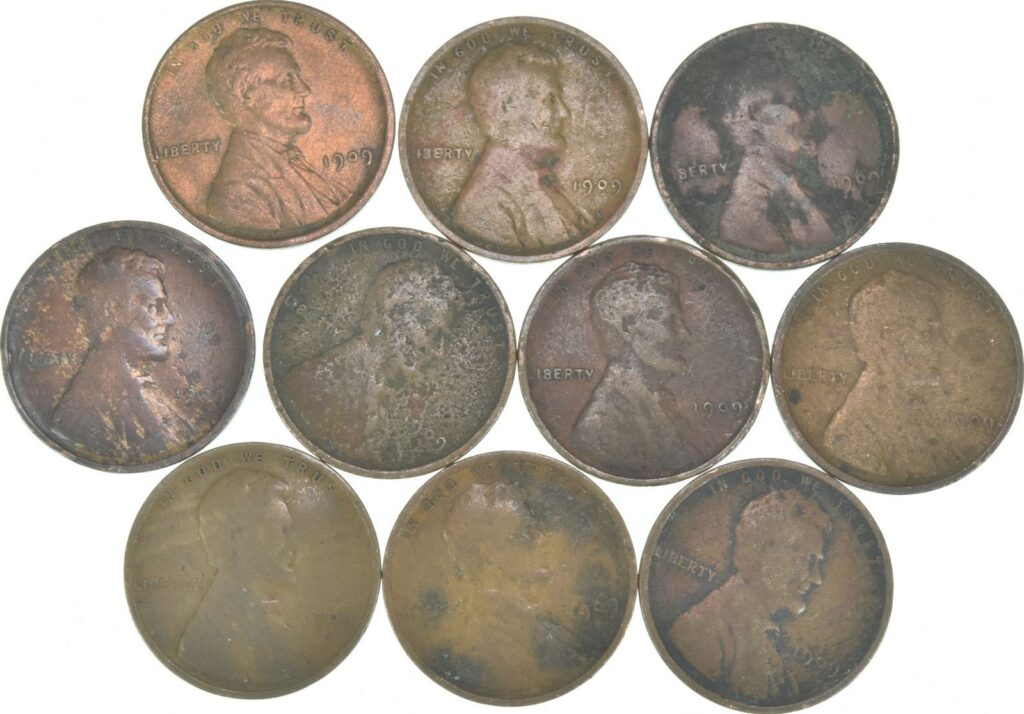
The Lincoln Cent, the design still used today, was introduced in 1909 to mark the 100th anniversary of Lincoln’s birth. Since then, it has undergone numerous changes in metal composition, reverse imagery, and size, but the iconic image has remained consistent.
High-Value Pennies
One of the most famous collectible pennies is the 1943 copper penny. Copper was deemed too vital for the war effort, so the Mint was asked to look for alternatives, settling on zinc-coated steel. However, some copper pennies were mistakenly struck that year and have become collectibles of extraordinary value—some selling for over a million dollars. The Mint initially denied the existence of these coins, but word spread fast regardless, and the pennies became a widely-known collectible. Due to the rarity of these coins, people have been making fakes since the 1950s, so any 1943 copper penny will require professional authentication. They can be worth hundreds of thousands of dollars.
Another interesting collectible penny is the 1955 doubled die cent. An error caused by misaligned machinery led this coin to have a double-printed image. It does not notably affect Lincoln’s face, but the lettering of “In God We Trust,” “Liberty,” and “1955” is all noticeably doubled. It’s estimated that about 40,000 of these were minted, about half of which were introduced into circulation. These pennies are rare today and can sell for around $100,000.
Another collectible penny—and a fascinating one from a historical perspective—is the 1909-S VDB cent. This penny was the first variant of the Lincoln Cent produced, but it had the initial VDB on the back, after the artist of the Lincoln image, Victor David Brenner. When it was released on August 2, 1909, public enthusiasm was such that police had to be deployed in New York to control the populace, who were scrambling to get the new coins.
Brenner’s initials soon caused controversy, with some government officials considering it a brazen act of self-promotion. Secretary of the Treasury Franklin MacVeagh was not happy, and soon, the decision was made to withdraw the coin mere days after issuing it. The Washington Post ran the headline “V.D.B. CENT DOOMED” on August 6, and collectors immediately began rushing to grab as many coins as possible, fearing government employees would be sent to recover them. Businesses even started using the pennies as promotional aids, promising to give customers a free penny along with product purchases, and opportunists began to sell the coin for up to 25 cents.
While over 27 million VDB coins were minted in Philadelphia, less than half a million were produced in San Francisco, making that variant a prized collectible.
Is It Worth It?
If you’re hoping that any old penny will become a major collectible, the bad news is that most one-cent coins will likely remain just that for years to come unless they have notable production errors. Even pennies from past decades will continue to be worth their face value.
Alan Kruml, WorthPoint’s numismatic expert, believes that the withdrawal of the penny will lead to increased interest from collectors, particularly in early and rare coins. He also thinks that coin “marketing” companies will promote cents and sell them at inflated prices. However, he doubts that the resale of these coins at a premium will be sustainable in the long run.
Collectors who are interested in rare and unique coins may want to focus on specific years or minting errors. If the penny is permanently discontinued, the demand for rarer pennies is likely to increase. The examples mentioned in this article represent only a small fraction of the many intriguing rare variants that are worth collecting.
Of course, collecting isn’t always about finding the rarest valuables—starting a collection of regular pennies from across the years can be a reasonably inexpensive way to preserve history, especially as the cent may soon be a symbol of American culture consigned to the past.
Matthew Doherty is a writer, editor, and teacher specializing in all things history-related. His work has been published in the UK Defence Journal, the Small Wars Journal, and The Collector. He holds an MSc from the University of Edinburgh and a BA from the University of Leeds. In his spare time, he also writes science fiction stories.
WorthPoint—Discover. Value. Preserve.
Credit: Source link